Permitting is the part of a commercial EV charging project that owners underestimate and developers learn to respect. The physical install is fast. The paperwork that lets the install happen, and the sign-off that lets the chargers turn on, is where a well-run project pulls ahead of a stalled one. This article is the workflow, in plain language: which permits you actually need, what you submit and why, how the review stages fit together, the corrections that send EV projects back to the queue, and what genuinely speeds the process. It does not re-litigate which codes apply or what the timeline tables look like; those live in companion articles linked below. The focus here is the path a permit follows from application to a powered-on charger.
The permits a commercial EV project needs
There is no single "EV charging permit." A commercial project pulls a set of permits, and which ones depend on the scope of the work. Knowing the full set up front keeps a later permit from ambushing the schedule after the conduit is in the ground.
- Electrical permit (almost always). Adding charging circuits is an electrical alteration, and for commercial work that means an electrical permit in effectively every U.S. jurisdiction. This is the permit every project pulls.
- Building permit (often). Structural and civil work triggers a building permit on top of the electrical one: new concrete pads or footings for pedestals or DC fast charging cabinets, penetrations or new attachment points in a parking structure, a canopy or carport over the spaces, or a meaningful reconfiguration of the parking area.
- Fire permit or review (sometimes). Enclosed parking structures and high-power DC fast charging can draw fire-code review for clearances, placement, and occasionally suppression. This layer is evolving as the fire-safety community builds experience with battery fires, so the local position is worth confirming directly.
- Planning or zoning review (scope-dependent). Adding chargers to an existing lot usually does not change the use, so zoning rarely blocks it. It comes into play for standalone charging as a primary use, new canopies, large pricing or wayfinding signage, and work in historic districts.
- Encroachment or right-of-way permit (when work touches the public way). Trenching across a sidewalk to reach a transformer, a curbside charger on city-owned frontage, or any construction in the public right-of-way needs a permit from the agency that owns that ground, separate from the building department.
The substance of which codes and zoning rules apply, and how the NEC governs the electrical work, is covered in building codes and zoning. This article assumes you know which permits are in play and focuses on getting them issued.
Plan check and inspections are different stages
Two words get used loosely and mean very different things. Getting them straight is the key to understanding the whole workflow.
Plan check (also called plan review) is the review of your submitted drawings, before any work happens. A plan examiner reads the single-line diagram, the load calculation, the site plan, and the accessibility details, and confirms the design meets code on paper. The output is either an approved plan set and an issued permit, or a correction notice listing what has to change. Plan check is a desk activity, and for a simple job some jurisdictions do it over the counter in an hour or less.
Field inspections happen during and after construction. An inspector visits the site and confirms the installed work matches the approved plans and meets code in the field. Inspections are staged: typically a rough-in inspection before anything is covered up, and a final inspection once the work is complete, with utility acceptance testing for larger projects.
The Authority Having Jurisdiction (AHJ) is the local official with final say over both stages, usually the building department's plan examiner and electrical inspector. The AHJ interprets the adopted code, approves the plans, and signs off the installation. The same authority that reviews your drawings is the authority whose inspector walks the site, which is why a contractor who already knows your AHJ is worth more than the rate sheet suggests. The AHJ can require changes even to work that arguably meets code if it presents a genuine safety concern.
The short version: plan check reviews the paper, inspections check the work, and the AHJ runs both. A permit is what bridges them, issued when plan check clears and required before the final sign-off that lets you energize.
The workflow, step by step
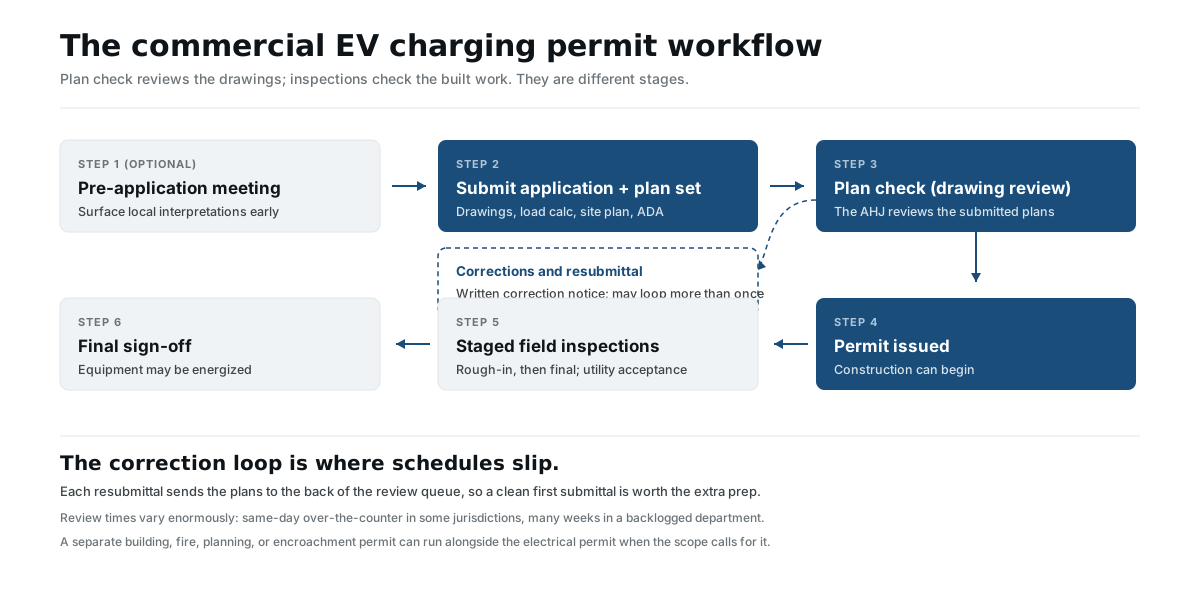
A commercial EV charging permit follows a predictable path. The names vary by jurisdiction, but the shape holds.
- Pre-application or counter meeting (optional, recommended for large or first-of-kind projects). A short meeting with the building department surfaces AHJ-specific interpretations before you formally apply: which code edition is in force, whether a separate fire or planning review applies, what the local checklist demands. It is the cheapest way to avoid a correction cycle.
- Submit the application and plan set. You file the permit application with the scope of work and the drawing package. What is in that package is the subject of the next section, and a complete package here is the single biggest lever on how fast the rest goes.
- Plan check and review cycles. The plan examiner reviews the drawings. For a straightforward job this can be same-day over the counter; for a larger or more complex one it is a back-office review that takes anywhere from a few days to many weeks depending on the department's workload.
- Corrections and resubmittal. If the reviewer finds problems, it issues a written correction notice itemizing the deficiencies. You revise the drawings and resubmit. This can loop more than once, and each resubmittal generally sends the plans back into the review queue rather than to the front of the line. The correction loop is where schedules quietly slip.
- Permit issued. When the plans clear, the AHJ issues the permit and construction can begin. Procurement and any utility interconnection work should already be running in parallel by this point, not waiting for the permit.
- Staged field inspections. As the work proceeds, the inspector visits at defined stages: a rough-in inspection before conduit and connections are covered, then a final inspection when the installation is complete. DC fast charging and larger sites often add a pre-construction meeting and utility acceptance testing.
- Final sign-off. A passed final inspection produces the sign-off that, in most jurisdictions, is required before the utility will set the meter and energize the service. Until that sign-off lands, the chargers stay off, no matter how finished they look.
What you submit, and why each piece matters
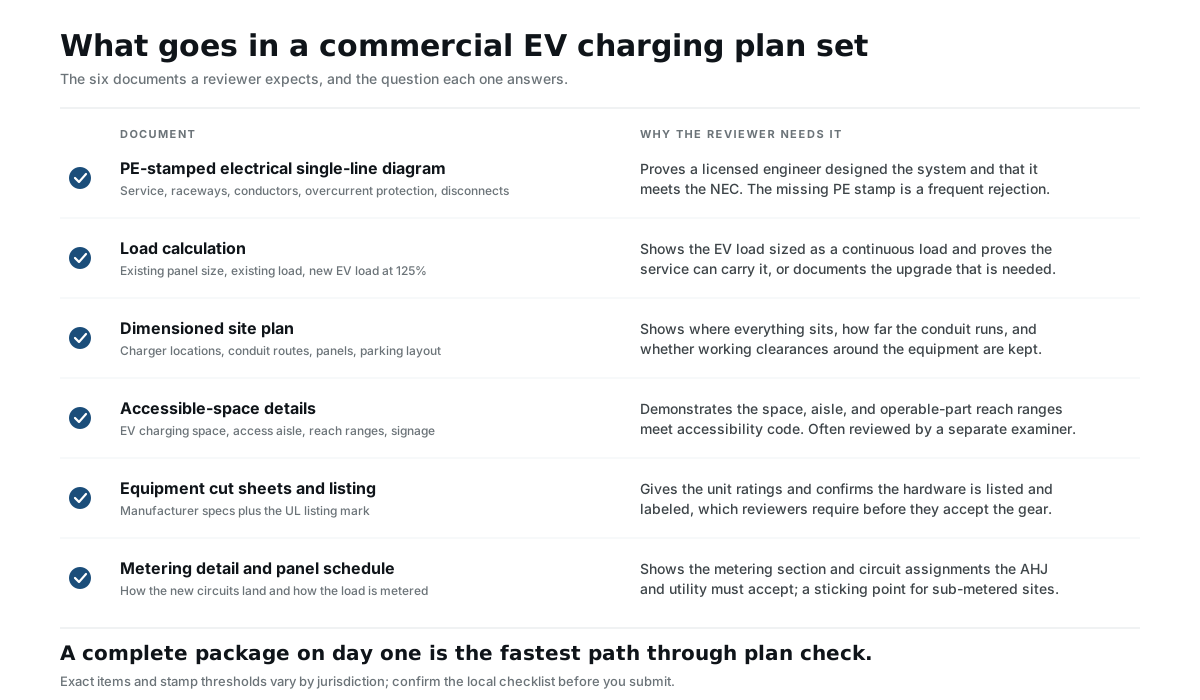
Plan check is only as fast as the package you hand the reviewer. A commercial EV plan set is built to answer the examiner's questions before they are asked. Six documents carry most of the weight.
A PE-stamped electrical single-line diagram. The single-line (or one-line) diagram is the electrical map of the project: the service, the raceways, the conductors, the overcurrent protection, the disconnects, and how the new chargers connect to all of it. For commercial work above a modest size, the electrical plans must be signed and stamped by a licensed professional engineer. The stamp is the reviewer's assurance that a qualified engineer designed the system, and a missing stamp is one of the most common reasons a submittal bounces.
A load calculation. This is the math that proves the electrical service can carry the new load. It states the existing panel size, the existing load already on it, and the new EV load, and demonstrates there is adequate capacity or documents the upgrade that is required. EV charging is treated as a continuous load, so the calculation has to size the supply to at least 125 percent of the equipment's rated load. Get the underlying assessment right before you submit; the electrical infrastructure assessment article covers how that load calculation is built and what it has to account for.
A site plan. A dimensioned plan showing the existing building and parking, where the proposed charging spaces and equipment go, the conduit routes, and the panel and sub-panel locations. The reviewer reads it to understand how far the wiring runs, where the equipment sits, and whether the required working clearances around that equipment are preserved.
Accessible-space details. Drawings showing the EV charging space, its access aisle, the operable-part reach ranges, and the signage, demonstrating the installation meets accessibility code. This is frequently reviewed by a separate accessibility examiner, and it is a recurring source of corrections. The full requirements are involved enough to warrant their own treatment in ADA requirements for EV charging.
Equipment cut sheets and listing. The manufacturer specification sheets for the chargers, including ratings and installation guidance, plus evidence that the equipment is listed and labeled by a recognized testing laboratory. Reviewers generally will not accept hardware they cannot confirm is listed, so this is both a safety requirement and a precondition for approval.
A metering detail and panel schedule. A panel schedule shows how the new and existing circuits land on the panel serving the chargers, and a metering detail shows how the load is metered. For sites that sub-meter the chargers or add a dedicated metering section, getting the utility and the AHJ to accept that arrangement is a common sticking point worth resolving early.
The rejections that are specific to EV charging
Plan reviewers see the same EV-charging mistakes repeatedly. Knowing the pattern lets your designer head them off before the first submittal, which is the difference between one review cycle and three.
- Continuous-load sizing. The most common technical correction. EV charging is a continuous load, so conductors and overcurrent protection must be sized to at least 125 percent of the rated load. A submittal that sizes a 48-amp charger to a 50-amp circuit instead of a 60-amp circuit gets kicked back. Across a bank of chargers, this is also what frequently forces a larger service.
- Working clearances. The code reserves dedicated working space in front of electrical equipment so it can be serviced safely. The required depth depends on voltage and what is across from the equipment, and at commercial EV voltages it commonly runs deeper than the three-foot minimum many people assume; the working space must also be at least as wide as the equipment or 30 inches, whichever is greater, and the dedicated space above the equipment must be kept clear. A panel or charger crammed into a tight electrical room or boxed in by parking is a frequent rejection, and one that is expensive to fix after the fact.
- Metering section acceptance. Sub-metered configurations and added metering sections have to satisfy both the AHJ and the utility. A metering arrangement the utility will not accept stalls the project regardless of whether the rest of the design is clean.
- Accessibility route and space dimensions. Access aisles that are too narrow, charging spaces that miss the required dimensions, operable parts outside the allowed reach ranges, and missing or non-compliant signage are recurring corrections, often flagged by a dedicated accessibility reviewer.
- A missing or wrong professional engineer stamp. For projects above the local threshold, plans without a PE stamp, or stamped by an engineer not licensed in that state, are returned unreviewed.
- Designing to the wrong code edition. Jurisdictions adopt the NEC on different cycles and add local amendments. A package designed to an edition the jurisdiction has not adopted, or that ignores a local amendment, draws corrections even when the underlying engineering is sound.
Most of these trace back to a single root cause: a designer without commercial EV experience in that specific jurisdiction. The cheapest fix is upstream, in who prepares the plans.
What speeds review, and what slows it
Review time for a commercial EV charging permit is not a fixed number. It ranges from same-day over-the-counter approval in an EV-experienced jurisdiction to many weeks in a backlogged department. Several levers move it.
What speeds it:
- A complete, correct first submittal. The single biggest factor. A package that answers every question on the local checklist, with the PE stamp, the continuous-load math, and the accessibility details all in order, can clear in one cycle instead of three. Pull the jurisdiction's published EV charging checklist and build to it exactly.
- A pre-application meeting for large or unusual projects, which catches the local interpretation that would otherwise become a correction.
- A designer and contractor with a local track record. Ask directly how many commercial EV permits they have closed with your AHJ. Familiarity with the examiner's expectations shortens review.
- Expedited review, where offered. Many jurisdictions offer expedited or priority plan check for an additional fee. If the schedule is tight, ask whether it is available.
- Online submittal, which more jurisdictions now accept and which removes the counter trip and the mail cycle from each resubmittal.
What slows it:
- An incomplete package, which buys a correction notice and a second trip through the queue.
- Department backlog, which fast-growing cities can develop with little warning and which you do not control.
- The correction loop itself, because each resubmittal generally re-enters the review queue rather than jumping the line. Two avoidable corrections can add weeks.
- A separate fire or accessibility review routed to a different examiner with its own backlog, running in series rather than parallel.
Inspections have their own cadence and their own waits. Inspectors are often booked a week or two out, so the rough-in and final inspections each carry scheduling lead time that should be built into the plan. The detailed schedule, including how permitting and inspections sit alongside procurement and utility work, is laid out in realistic timelines and delays.
A worked example: California's streamlined EV permitting
California is the clearest example of a state legislating faster EV charging permits, and it is instructive even outside California because it shows what a streamlined process looks like.
Two statutes drive it. AB 1236 (2015), codified at Government Code section 65850.7, required every city and county in the state, including charter cities, to adopt an expedited, streamlined permitting process for EV charging stations. Under that process the review is administrative and checklist-based rather than discretionary: a jurisdiction publishes a checklist of what a compliant application must contain, accepts electronic submittal and electronic signatures, and approves an application that meets the checklist without a discretionary public hearing. The aim is to take EV charging out of the slow, case-by-case land-use track and put it on a fast, ministerial one.
AB 970 (2021), codified at Government Code section 65850.71, added review clocks to that process. For a project of 1 to 25 charging stations, the agency has five business days to determine whether the application is complete; for more than 25 stations, it has ten business days. If the agency finds the application incomplete, it must issue a single written correction notice itemizing every deficiency. If it neither deems the application complete nor issues that notice within the window, the application is deemed complete by operation of law. Once complete, the agency then has a defined period to act on the permit. Separately, the U.S. Department of Energy's national permitting guidance describes the broader pattern many jurisdictions follow, which is not the California statute itself: on the order of 20 business days to approve a smaller application and roughly 40 for a larger one, with the permit often deemed approved if the agency takes no action. Confirm the exact clock with your jurisdiction. Some California cities have gone further and offer EV charging permits online or over the counter.
The point of the example is not that every project sits in California. It is that the workflow above is the same everywhere, and a jurisdiction can compress it dramatically when the law requires a checklist-based, deadline-bound, ministerial process. Most jurisdictions have no such statute, and review times there vary enormously, from same-day to many weeks. Before you assume either a fast or a slow process, check whether your state has a streamlining law and pull the local jurisdiction's published EV charging checklist; that single document tells you most of what plan check will expect.
Where permitting fits in the project
Permitting is one workstream among several, and the projects that finish on time are the ones that run it in parallel with the others rather than in sequence. Order the equipment when the design is locked, not when the permit clears. Start any utility interconnection early, because it is usually the longest pole and the permit does not gate it. File grant and make-ready applications on their own clocks. Treat the permit as the thing that lets construction begin, and arrange the slower, externally controlled items so they are already moving when it lands. How the permit sits inside the full scope of a commercial install, from assessment through commissioning, is covered in what commercial installation involves.
One scheduling note specific to mid-2026: the federal 30C charger tax credit is framed throughout this site as effectively closed, because its placed-in-service deadline is unreachable for a project starting now. Do not let a permit timeline get built around a credit a new project cannot realistically capture; plan the project on its own economics and confirm any credit treatment with a tax professional.
The bottom line
Permitting rewards preparation. The workflow is predictable: an optional pre-application meeting, a submittal, plan check, a correction loop you want to minimize, an issued permit, staged inspections, and a final sign-off that lets you energize. Plan check reviews the drawings and inspections check the work; the AHJ runs both. The biggest lever you control is the quality of the first submittal, a complete plan set with a PE-stamped single-line, a continuous-load calculation, a dimensioned site plan, accessibility details, and listed-equipment cut sheets, built to the local jurisdiction's published checklist. Review times vary enormously by jurisdiction, so confirm the local process early, hire people who have closed EV permits with your AHJ, and run permitting in parallel with procurement and utility work rather than waiting on it.
Last factually verified: 2026-06-19 against California Government Code sections 65850.7 (AB 1236) and 65850.71 (AB 970) and the California Legislature bill text, the California GO-Biz (Governor's Office of Business and Economic Development) EV charging permit streamlining materials, the U.S. DOE Alternative Fuels Data Center permitting processes guidance for EV charging infrastructure, NEC (NFPA 70) Article 625 and section 110.26 working-clearance references, municipal EV charging submittal checklists and commercial EV permit-process pages (City of Los Angeles, Los Angeles County, South San Francisco, Montgomery County MD), and IRS.gov Section 30C guidance. Permit requirements, checklists, stamp thresholds, and review times vary by jurisdiction and adopted code edition; confirm with your local AHJ.