Once you know your EV project needs more power than your existing service can carry, a different organization takes over a large part of the schedule: the utility. Getting that power is not a purchase you complete with a phone call. It is a formal application, with its own steps, its own paperwork, and its own cost-sharing rules, and the parts of it that take the longest are the parts you do not control. This article walks through how a commercial EV project actually gets served, who pays for what, and why the utility's timeline, not your contractor's, usually decides when the chargers turn on.
This is the process article. Whether you need an upgrade at all is a separate question, answered by an electrical infrastructure assessment. How long the whole project runs end to end, including permitting and construction, is covered in realistic timelines and delays. Here we stay on the application and interconnection itself.
When a project triggers a service application
Anything that adds electrical load beyond what your existing service and meter already carry puts you in front of the utility. EV charging is a large, sustained load, so it crosses that line easily. A handful of Level 2 ports on a building with spare capacity might clear with a simple notification. A new bank of fast chargers, a dedicated EV service, or any project that needs a larger transformer is a full service application.
In practice, you are triggering a utility application if any of the following is true:
- You are adding more load than your service was sized for, and a load calculation confirms you are over.
- You want a new, separately metered service for the chargers rather than feeding them from the building.
- The site needs a new or larger utility transformer to carry the load.
- You are extending the utility's lines to reach the site or the parking area.
If none of those apply, you may only owe the utility a notification rather than a planning study. The way to find out is to ask early, which is exactly where the workflow starts.
The workflow, step by step
Every utility runs some version of the same sequence. The names differ by territory, but the shape is consistent: you tell the utility what you need, the utility decides whether and how it can serve you, the utility designs and prices any work, you sign and pay, and then the utility builds and energizes. The labeled flow below shows the seven stages and, just as importantly, who owns each one.
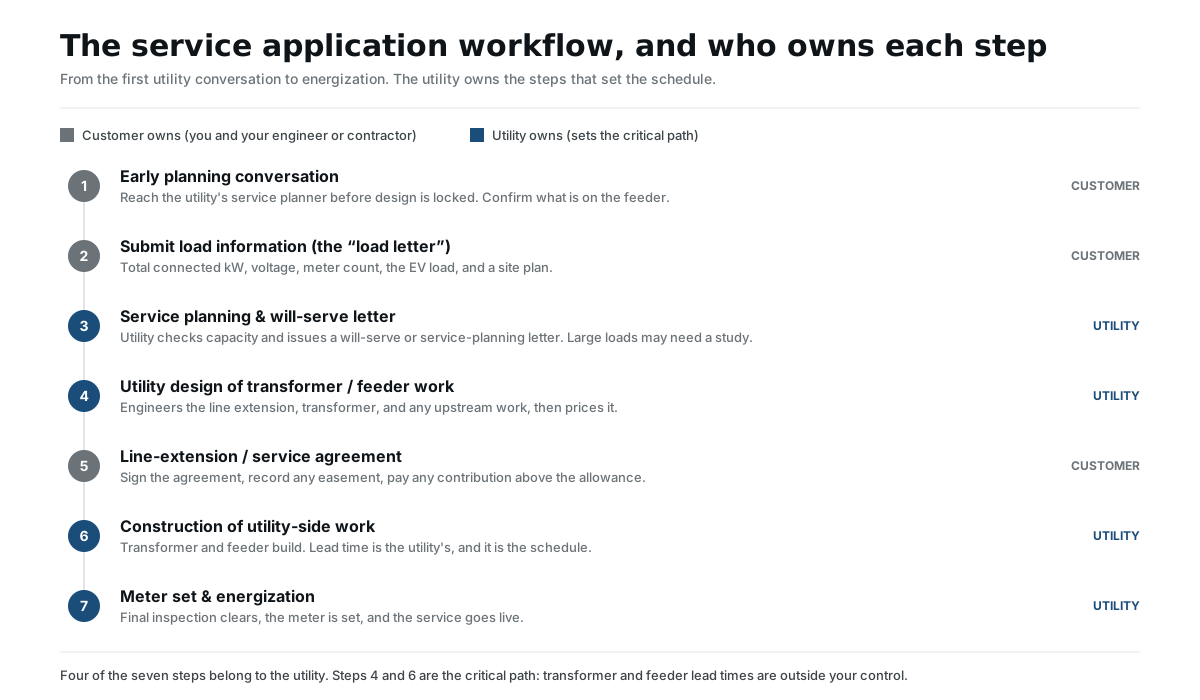
1. The early planning conversation
Before you finalize a design or a port count, talk to the utility's service planner, sometimes called a new-business or service planning representative. This is not a formality. The planner can tell you, often quickly, whether the feeder serving your site has capacity, whether a transformer upgrade is likely, and roughly how their queue is running. A fifteen-minute conversation here can save a redesign later, because it surfaces constraints while your plans are still on paper rather than poured into concrete.
This early call is also where you learn which application path applies to you: a light-touch load notification, a standard line extension, or, for a large load, a capacity study. Get that answer before you commit to equipment.
The utility cannot plan service it does not understand, so the first formal deliverable is your load data, often called a load letter or customer load information. This is a description of the electrical demand you are asking the utility to serve. For a commercial EV project it typically includes:
- Total connected load and expected peak demand, in kW or kVA
- The service voltage you want (for example 208Y/120V or 480Y/277V)
- The number and type of meters
- The EV charging load specifically, including charger count, port power, and whether load management caps the peak
- A site plan or vicinity map showing where the service and chargers go
A licensed engineer or your commercial electrician usually prepares this, because the load figure has to be defensible. Underestimate it and the utility designs a service that cannot carry your real peak; overestimate it and you pay for capacity you will never use, and you may earn a smaller cost allowance than you should. Get the number right.
3. Service planning and the "will-serve" letter
The utility now studies your request against its system and tells you whether and how it can serve you. The output is a written confirmation, commonly called a will-serve letter, an ability-to-serve letter, or a service-planning letter depending on the territory. It states that the utility has, or can build, the capacity to serve your load at the requested point.
This document does more than reassure you. In many jurisdictions a will-serve letter is a prerequisite for your local planning approvals and your building permit, so the entitlement and permitting tracks cannot finish without it. Start it early for that reason alone.
For a large load, this stage is where a deeper review can appear. If your demand is big enough to stress the local distribution system, the utility may require a distribution capacity study or interconnection study before it will commit. That study has its own cost, its own deposit, and its own queue, and it is more common as you move into DC fast charging and high-power sites. Treat a study as a real possibility for any site drawing several hundred kW or more, and ask about the threshold during the step-one conversation.
If serving you requires new utility infrastructure, the utility's engineers design it: the line extension from the nearest adequate facilities, the transformer, and any upstream work. They then produce a cost estimate, which becomes the basis for your agreement and your bill. You do not design this and your contractor does not either; it is the utility's distribution system, so the utility owns the design.
This is the first of the two stages that quietly set your whole schedule, because designing and then ordering a transformer is where utility lead times live. More on that below.
5. The line-extension or service agreement
With a design and a price in hand, the utility offers an agreement: a line-extension agreement, a service agreement, or both. Signing it commits you to the project and to your share of the cost. Two things commonly travel with it:
- An easement, if the utility needs to run or maintain equipment across your property. Easements have to be recorded, and utilities generally will not build until the recording is done, so a slow title process here delays construction.
- A contribution, if the cost of serving you exceeds the allowance the utility grants. This is the cost-allocation step, explained in the next section.
6. Construction of the utility-side work
The utility builds what it designed: sets the transformer, pulls the feeder, and makes the connection ready. This is the second schedule-setting stage. The physical build can be quick once materials are on hand, but waiting for the transformer to arrive frequently is not. The lead time belongs to the utility and its supply chain.
7. Meter set and energization
After the utility-side work is built and your behind-the-meter work passes inspection, the utility sets the meter and energizes the service. The chargers can now draw power. Energization is the finish line of the interconnection, though commissioning and network activation of the chargers still follow.
Cost allocation: allowance, then contribution
The most misunderstood part of the whole process is who pays for the new utility infrastructure. The general model, used in some form across most regulated utilities, has two pieces:
- A line-extension allowance. The utility funds a portion of the extension and recovers it over time through your bills. The size of the allowance is usually tied to the revenue the utility expects to earn from your new load: more expected usage earns a larger allowance.
- A contribution in aid of construction. If the estimated cost of serving you is more than the allowance covers, you pay the difference up front. This contribution is generally due before construction begins and is commonly nonrefundable, though some tariffs allow partial refunds if additional load connects to the same extension within a set window.
The exact formula is not something you can read off a national rulebook, because it lives in each utility's tariff and is set by the state utility commission. In California, for example, investor-owned utilities allocate distribution line and service extensions under tariff Rules 15 and 16, with the allowance and the customer contribution defined there. Other states and municipal or cooperative utilities have their own equivalents. The structure rhymes across the country; the numbers do not, so always confirm against your own utility's current tariff.
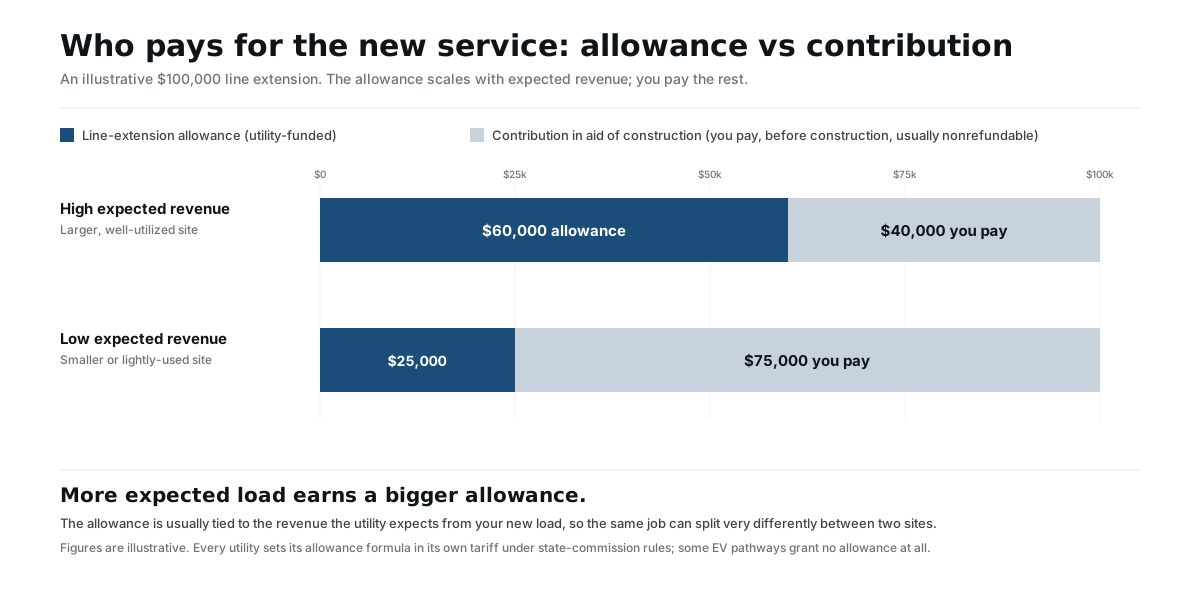
A worked example makes the mechanics concrete. Suppose serving your project requires $100,000 of utility-side work. The utility estimates the revenue your new load will generate and grants an allowance against it. On a larger, well-utilized site, that allowance might cover $60,000, leaving you a $40,000 contribution. On a smaller or lightly used site with the same $100,000 of work, the allowance might be only $25,000, leaving you to contribute $75,000 for an identical scope. The work did not change; the expected revenue did, and that is what moved your bill. The figures here are illustrative. The point is the shape: more load earns a bigger allowance, and you pay whatever the allowance does not cover.
One more wrinkle worth flagging: a dedicated EV pathway may not grant an allowance at all, and instead change who owns the equipment. The SDG&E example below is exactly that case.
Who owns the timeline
Here is the single most important thing to internalize about interconnection: the utility owns the steps that set the schedule, so the utility owns the timeline.
Look back at the workflow. Of the seven stages, four belong to the utility, and two of those four, the design and the construction of any transformer and feeder work, are where the real delay lives. As of mid-2026, the United States is in a multi-year transformer shortage driven by surging data-center and grid demand and constrained production of the specialized steel these units use. Larger units can carry lead times measured in many months to years, and even routine distribution transformers run long in some territories. When your project needs the utility to set a transformer, that lead time is not a line item in your schedule; it is your schedule.
This reframes how you should plan:
- The contractor's build is the short, controllable part. The utility's design and procurement is the long, externally controlled part.
- The application is not paperwork to do after you have lined up a contractor. It is the long pole, so it goes first.
- Your behind-the-meter work and the utility's service work can run in parallel, but only the utility can tell you when its side will be ready, and that date governs.
Because the schedule itself is such a large topic, the phase-by-phase timing, permit queues, and the transformer shortage are covered in depth in realistic timelines and delays. The takeaway to carry into the application is simply this: start the utility conversation first, because everything downstream waits on it.
Primary versus secondary service
Somewhere in the application, usually once the load is large, the utility will raise a structural question: should you take service at secondary voltage or primary voltage? The answer changes who owns the transformer, and it is partly an application decision, not just an engineering one.
- Secondary service is the default for most commercial sites. The utility owns the transformer, steps the voltage down to a usable level (such as 480Y/277V or 208Y/120V), and meters you on the low-voltage side. You take service ready to use. This is simpler and is what most Level 2 and mid-size projects use.
- Primary service means the utility delivers power at medium voltage and you own the transformer that steps it down. You take responsibility for buying, installing, and maintaining that transformer and the gear around it, and the utility meters you on the primary side.
Why would anyone choose to own a transformer? For large loads, primary service can lower your rate (primary tariffs are often cheaper per kWh and per kW), give you more control, and in a transformer-constrained territory it can be faster, because you are not waiting in the utility's transformer queue. The trade is real capital cost and ongoing ownership of equipment most owners would rather the utility handle. Above a certain size, the utility may require primary service rather than offer it as a choice.
This decision interacts tightly with the service equipment you buy, the metering method, and the utility's size caps. The equipment side of it, switchboards, CT versus self-contained metering, and where the utility forces a switch, is its own subject, covered in switchgear and service equipment. For the application, the thing to settle early is which side of the transformer you sit on, because it reshapes the cost allocation and the gear you have to design in.
When a study enters the picture
For most projects, the will-serve letter is the utility's whole answer. For large loads, it is not. When the demand is big enough to affect the local distribution system, the utility may require a formal distribution capacity or interconnection study before committing to serve. The study models your load against the feeder and substation and identifies any upstream upgrades the utility would have to make.
Two things to know about studies:
- They are more likely as power rises. A cluster of Level 2 ports rarely triggers one. A high-power DC fast-charging site, especially one drawing several hundred kW or more, often does. Megawatt-scale fleet depots almost always do.
- They have their own cost and queue. Expect a deposit and a wait, and budget the study's timeline on top of the standard application, not inside it. If the study finds that a substation or major feeder upgrade is required, both the cost and the schedule can jump well beyond a routine line extension.
Ask whether a study is required during the first conversation. Finding out three months in is an expensive way to learn it.
A named worked example: SDG&E's EV infrastructure pathway
To make the general process concrete, it helps to look at one utility's dedicated EV pathway, while remembering that every utility has its own and the names differ.
San Diego Gas & Electric created an EV-specific new-service path called the EV Infrastructure Rule, filed as its tariff Rule 45. It was built for separately metered EV charging sites that are not single-family homes, across light-, medium-, and heavy-duty charging. What made it distinctive is how it handled the make-ready: instead of granting a line-extension allowance the way a standard extension does, SDG&E was authorized to design, install, own, and maintain the electrical equipment between its distribution system and the customer's meter. In other words, the utility took ownership of the make-ready up to the meter, rather than building it and charging the customer a contribution for the excess.
That is a meaningfully different deal from a conventional Rule 16 extension. Under the standard path you typically get an allowance and pay a contribution for anything above it, and you own the resulting service equipment up to the utility's delivery point. Under the Rule 45 path, the utility carried and kept the make-ready to the meter, which lowered the customer's upfront infrastructure cost in exchange for the utility retaining the asset.
Two caveats keep this honest. First, programs like this are funded and capped by the state commission, and that funding can close. SDG&E closed Rule 45 to new applications effective August 20, 2025, after the program hit a funding cap set in its 2024 General Rate Case, and moved to terminate contracts that had not received a notice to proceed. So the specific program is not a live option today. Second, and more durably useful: the lesson is structural, not specific to San Diego. Many utilities run an EV make-ready or new-service offering that changes the standard cost-allocation and ownership math, whether by funding the infrastructure, owning it, or both. These overlap with, and are sometimes the same thing as, the make-ready funding programs covered in utility make-ready programs. Ask your utility which EV-specific service paths exist before you default to the standard line extension, because the standard path is not always the cheapest one available to an EV project.
How states are trying to put a clock on it
Because utility-controlled timelines are the chronic problem, some states have started setting energization deadlines. California is the clearest example. Under SB 410, the state directed its utility commission to establish target timeframes for connecting and upgrading customers, and in 2024 the commission adopted those targets for the three large investor-owned utilities, organized around the same tariff rules that govern extensions. Separately, a 2023 California law, AB 1482 (not the 2019 rent statute that shares the number), set an average service energization target of 125 business days for EV charging infrastructure served by publicly owned utilities such as municipal utilities, with carve-outs for very large projects (above 2 megawatts) and any project needing a substantial upstream or substation upgrade.
Two cautions before you lean on any of this. The published targets are averages and maximums with real exclusions, not guarantees for your specific project, and the exact figures and categories differ by source and by utility, so confirm the current target with your own utility rather than quoting a number from memory. And these rules are California's; most states have no such deadline at all, which is precisely why early engagement matters everywhere. A deadline on paper does not move a transformer that has not arrived. The reliable lever is still to start the application first and run everything else in parallel behind it.
The bottom line
The interconnection is not the part of an EV project you do once the interesting decisions are made. For any site that needs more power, it is the project's spine. The utility decides whether it can serve you, designs and prices any new infrastructure, grants an allowance, charges you the excess, and then builds and energizes on a clock that is mostly its own. Your job is to enter that process early and well prepared: have a defensible load number, start the will-serve letter before you need the permit, ask on day one whether a study or a transformer is in play, and settle the primary-versus-secondary question before you buy equipment. Do that, and the utility's timeline becomes something you planned around. Skip it, and it becomes the reason the chargers are not on.
The application sits in the middle of a larger sequence. To see where it falls relative to assessment, equipment, permitting, and construction, read what commercial installation involves.
Last factually verified: 2026-06-19 against San Diego Gas & Electric's Rule 45 EV Infrastructure Rule materials (program scope and the August 20, 2025 closure to new applications under the 2024 General Rate Case funding cap), the CPUC's California electric tariff Rules 15 and 16 (distribution line and service extensions, allowances, and contributions in aid of construction), CPUC Decision 24-09-020 implementing SB 410 on energization target timeframes for the large investor-owned utilities, California AB 1482 (the 125-business-day publicly owned utility EV energization target and its exclusions), the U.S. Joint Office of Energy and Transportation guidance on utility collaboration and EV interconnection, and 2026 industry reporting on the distribution and power transformer shortage and lead times. Allowance and contribution figures in this article are illustrative; cost-allocation formulas are tariff- and jurisdiction-specific and should be confirmed against your own utility's current tariff.