The chargers are mounted, the conduit is run, and the panel is wired. It is tempting to think the project is basically done. It is not. The last stretch, going live, is a fixed sequence of dependencies, and the order is not optional. You cannot energize the service before the utility sets the meter and the local inspector signs off, and you cannot commission the network and payment functions before the service is energized. Owners who treat go-live as a single flip-the-switch moment are the ones who get surprised by a charger that powers up but will not take a payment, or by an incentive clock that started later than they assumed. This article walks the go-live order, explains what "placed in service" actually means for your tax and incentive paperwork, and covers the acceptance and handover steps that decide how well the site runs for the next several years.
The go-live sequence, and why the order is fixed
Commissioning is the structured process of bringing the installed equipment from "physically present" to "working and accepted." It sits on top of a chain of approvals and utility actions that have to happen in order. Skipping ahead is not just risky, it is usually impossible: the next step physically cannot start until the prior one is complete.
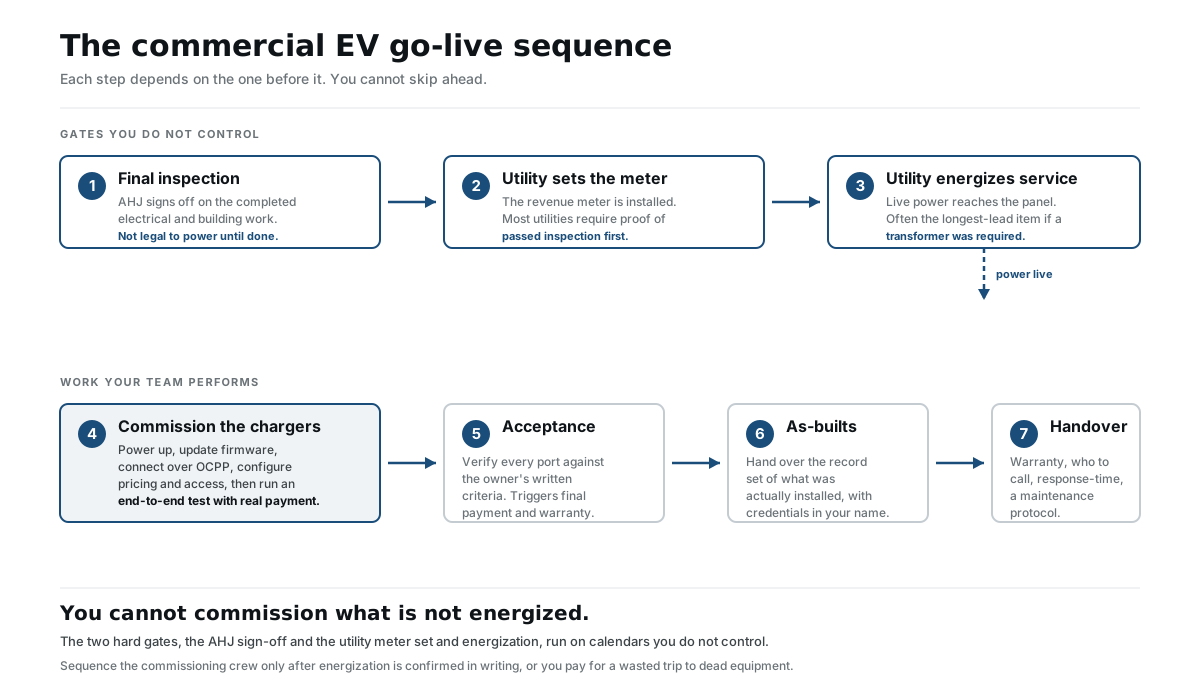
Here is the chain in plain terms.
-
Pass final electrical and building inspection (AHJ sign-off). The authority having jurisdiction, usually your city or county building and electrical department, inspects the completed work and issues a final approval. Until this happens, the installation is not legally cleared to be powered. The codes and inspection scope that govern this sign-off are covered in building codes and zoning.
-
The utility sets the revenue meter. Most utilities will not set the permanent meter until they have evidence of the passed final inspection. The meter is what measures the electricity you will be billed for, and on metered EV sites it is also what your tariff and any demand charges are calculated against.
-
The utility energizes the service. Energization is the utility actually closing the connection and delivering power to your new or upgraded service. On a simple panel addition this can follow the meter set quickly; on a project that required a new transformer or service upgrade it is a scheduled event the utility controls.
-
Commission the chargers. Only now, with live power, can the real commissioning work begin: power up each unit, apply firmware updates, bring the chargers onto the network and confirm the OCPP connection to your software platform, configure pricing and access rules, and run an end-to-end session test that starts a charge, delivers energy, stops cleanly, and processes a real payment.
-
Acceptance testing. Verify the commissioned system against the owner's written acceptance criteria, port by port.
-
As-built documentation. Assemble and hand over the record set of what was actually installed.
-
Operations-and-maintenance (O&M) handover. Transfer warranty terms, fault-response expectations, and the maintenance protocol to whoever will operate the site.
The reason this matters beyond tidiness: the two hard gates, the AHJ sign-off and the utility meter-set-and-energization, are outside your control and run on their own calendars. If you have scheduled an installer to commission on a Tuesday but the utility has not energized, the crew shows up to dead equipment and you pay for a wasted trip. Sequence the commissioning visit after energization is confirmed in writing, not before. For where these gates land in the overall project schedule, see realistic timelines and delays.
What "energization" actually involves
Energization is more than a switch. For a straightforward installation that fits within existing service capacity, the utility verifies the inspection, sets the meter, and the new circuits become live. For projects that required new infrastructure, energization is the culmination of the interconnection process: the utility confirms its upstream work (a transformer, a service upgrade, or new conductors) is complete and ties your service into the grid.
Two practical points. First, energization is frequently the longest-lead item in the whole project, because it depends on utility crews and equipment you cannot expedite. Second, the meter set and energization are sometimes a single coordinated visit and sometimes two separate ones; ask your utility account contact which it will be, and get the scheduled date in writing so you can sequence the commissioning crew behind it.
Commissioning the chargers, step by step
Once power is live, commissioning turns a powered unit into a working, networked, revenue-collecting charger. This is the step owners most often underestimate, because the physical install is visibly "done" but the system is not yet functional. The basics of network setup and a first post-install checklist are introduced in what commercial installation involves; this is the deeper version of that step.
A commissioning visit typically runs in this order:
- Power-up and self-test. Energize each unit and confirm it boots, passes its internal diagnostics, and shows no fault codes. Verify the unit is on the circuit and breaker the as-builts say it is on, mislabeled circuits are a common and time-consuming surprise here.
- Firmware updates. Chargers often ship with firmware that is months old. Update every unit to the version your platform expects. A firmware mismatch between the charger and the network is one of the most common reasons a charger powers up but will not communicate or behave consistently.
- Network connection and OCPP handshake. Bring each charger online over its cellular or wired backhaul and confirm it registers with your software platform over OCPP. The Open Charge Point Protocol is the open standard that lets chargers and management software talk to each other; the widely deployed versions today are OCPP 1.6 (including the JSON variant commonly written "1.6J," released in 2015) and OCPP 2.0.1 (released in 2020), with OCPP 2.1 published in January 2025 and backward compatible with 2.0.1. Confirm in writing which version your hardware and platform actually negotiate, because a charger and a platform that nominally "support OCPP" can still fail to pair if they are on different versions or use different optional features. Platform selection and what OCPP support to require are covered in software platforms for commercial charging.
- Configuration. Set pricing (per kWh, per hour, per session, or free), access rules (public, restricted to fobs or an app, or fleet-only), and any load-management or scheduling policies. Confirm the site, ports, and connectors are labeled correctly in the platform so a driver who calls support and your operator are looking at the same port.
- End-to-end session test. The single most important commissioning step. Run a complete real-world transaction on each port: initiate a session the way a driver will (app, fob, or tap-to-pay), confirm energy actually flows, stop the session, and confirm a real payment is captured and settles. A test that only checks "the charger turns on" misses the failures that actually strand drivers, which are almost always in the payment path or the network connection, not in the power electronics.
The common go-live failures
Most go-live problems cluster into a handful of repeat offenders. Knowing them lets you test for them deliberately rather than discovering them when the first paying driver does.
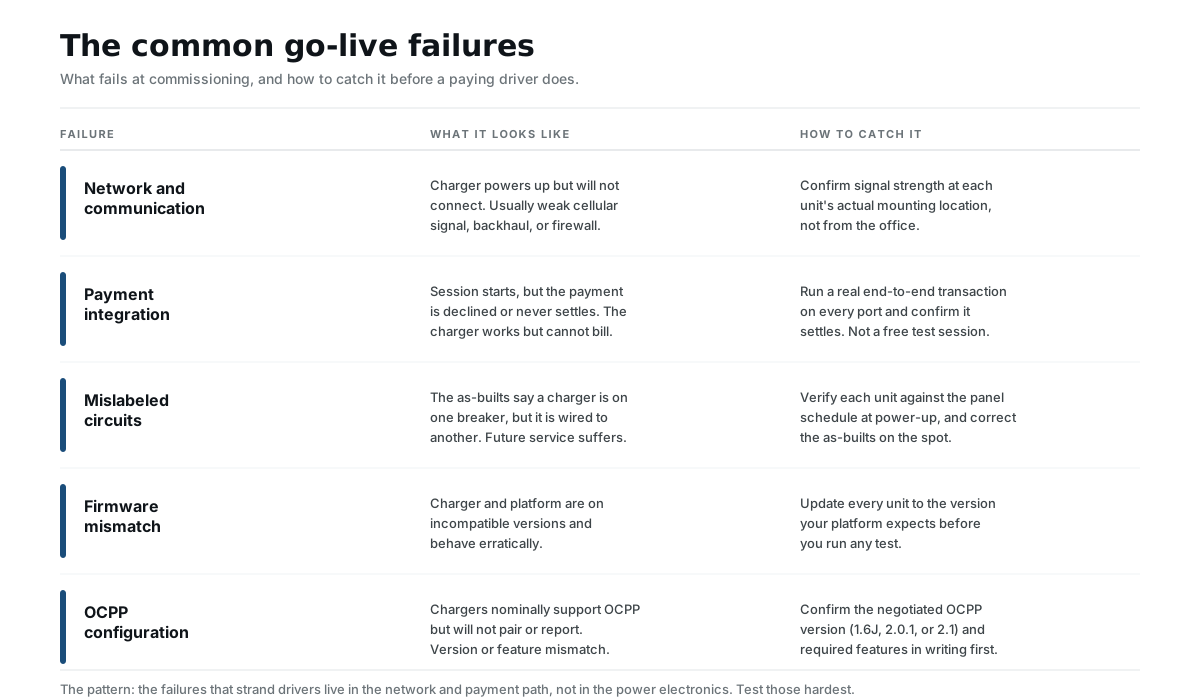
To restate the panel above in order of how often it bites:
- Network and communication. Weak cellular signal at the charger's actual mounting location, or a backhaul, firewall, or SIM-activation issue, leaves a charger unable to reach the platform. Test signal strength where the unit is installed, not where it is convenient.
- Payment integration. The most embarrassing failure mode: the charger works but cannot take money. Only a real transaction that settles proves the payment path end to end.
- Mislabeled circuits. A charger physically on a different breaker than the schedule claims complicates every future service call and load-management assumption. Verify at power-up.
- Firmware mismatch. Out-of-date or incompatible firmware causes erratic behavior and failed communication. Update before you test.
- OCPP configuration. Version and feature mismatches between charger and platform prevent pairing or reporting even when both "support OCPP." Confirm the specifics in writing up front.
"Placed in service" is a specific moment, do not guess it
For incentive, depreciation, and tax purposes, the moment that matters is not when the equipment was delivered, and not when it was physically installed. It is when the property is placed in service, which the IRS defines as the point at which it is ready and available for its specifically assigned function, even if you are not yet actively using it (IRS Publication 946; Treasury Regulation section 1.167(a)-11(e)(1)(i)). Publication 946 illustrates this with a vehicle that is placed in service on the date it is "ready and available" for its intended use, not the date it was bought.
For an EV charging site, "ready and available for its intended use" lines up with commissioning and energization, when the chargers are live, networked, and able to dispense energy and take payment, not with delivery and not with the day the conduit was buried. Treat these as four genuinely different dates and do not let your paperwork blur them:
| Milestone | What it means | Common mistake |
|---|
| Substantial completion | Construction is essentially finished, minor punch-list items may remain | Assuming this equals placed in service |
| Final inspection (AHJ sign-off) | The authority having jurisdiction approves the completed work | Assuming approval alone makes it operational |
| Energization | The utility delivers live power to the service | Assuming live power equals ready for use without commissioning |
| Placed in service | The property is ready and available for its intended use | Backdating to delivery or installation, or guessing the date |
This distinction has dollars attached. The federal Section 30C Alternative Fuel Vehicle Refueling Property Credit, for example, keys eligibility and the credit calculation to the placed-in-service date, and it treats each individual charging port (and each fuel dispenser) as a separate item of property. Note that 30C is, for any project starting now, effectively closed: it expires June 30, 2026 under the One Big Beautiful Bill Act (Public Law 119-21), a deadline that is unreachable for a new build given utility and permitting lead times, so plan around the real out-of-pocket cost rather than the credit. The broader point survives the specific program: any incentive or depreciation benefit you are counting on has a placed-in-service trigger, and you want your commissioning records to establish that date cleanly. The placed-in-service framing for federal programs is discussed further in federal programs: NEVI, CFI, IRA. For anything with real money attached, confirm the date and its consequences with your own tax advisor against current IRS guidance; the rules move.
Acceptance testing against written criteria
Commissioning proves the system functions. Acceptance is the owner formally agreeing that it functions to the standard that was promised. The difference matters because acceptance is usually the trigger for final payment and the start of the warranty clock, so you want it tied to objective, written criteria rather than a handshake.
Good acceptance criteria are specific and testable. For each port, you should be able to check and sign off:
- The port powers on and reports no active faults.
- The port is correctly identified in the management platform (right site, right label, right connector type).
- The port communicates with the platform and reports status and session data.
- A full end-to-end session completes: start, deliver energy at the rated power, stop, and a real payment captures and settles.
- Pricing and access rules behave as configured (a restricted port refuses an unauthorized start; the price charged matches the price set).
- Load management, if installed, actually limits draw as configured under a simulated simultaneous-start condition.
- Physical items are complete: bollards, signage, ADA markings and accessible route, and cable management.
Run the test on every port, not a sample. The whole point of acceptance is to find the one port that was wired to the wrong breaker or never got its firmware updated before that port becomes a driver's problem.
The as-built documentation package
As-builts are the record of what was actually installed, as opposed to what the original drawings proposed. On EV sites the two diverge constantly, a conduit run gets rerouted around an obstruction, a panel gets a different breaker layout, a charger lands in a slightly different spot. The as-built package is what makes the site serviceable and expandable for years; without it, the next electrician is reverse-engineering your site at your expense.
A complete handover package should include:
- Updated panel schedule showing every breaker, its rating, and which charger or load it feeds.
- Single-line (one-line) diagram of the electrical system as built, from the service through the panels to the chargers.
- Conduit routing photos and drawings, ideally taken before backfill, showing where underground runs actually go. These are irreplaceable once the trench is closed.
- Equipment serial numbers for every charger and major component, tied to location, so warranty claims and recalls can be matched to specific units.
- Network credentials and platform details: the accounts, SIM or connectivity details, and platform configuration needed to manage the site. Store these securely and make sure they survive a change of staff or vendor.
- Warranty documentation for hardware and workmanship, with start dates and terms.
- Permits and final inspection sign-offs, the closed-out approvals.
- Configuration record: the pricing, access, and load-management settings as they were set at acceptance.
The recurring failure here is that network credentials and platform ownership get left in the installer's name. If the relationship ends, you can lose the ability to manage your own chargers. Confirm at handover that the accounts, credentials, and platform administration are in your organization's name and control.
Operations-and-maintenance handover
Handover transfers the site from "built" to "operated." It is the difference between a charger that gets fixed in a day and one that sits dead for three weeks because nobody knew who to call. Pin down four things before you accept the project.
Warranty terms. Know what is covered (hardware, parts, labor), for how long, and what voids it. Hardware and labor warranties often have different lengths. Get the start dates in writing, they typically run from acceptance or placed-in-service, which is one more reason to nail that date down.
Who to call and the response-time expectation. Establish a single fault-reporting path and a written expectation for how fast a response and a fix will come. "Next business day remote diagnosis, on-site within X business days for a hardware fault" is a concrete commitment; "we'll get to it" is not. If you bought a service or maintenance plan, the response-time service level should be in the contract.
A maintenance protocol. Decide and document who does routine checks, how a driver-reported fault gets escalated, and what the preventive-maintenance cadence is (visual inspection, connector and cable condition, software updates). Even a simple written protocol beats an undocumented assumption that "the platform will tell us."
Uptime and reporting basics. Your management platform reports each port's status, session counts, energy dispensed, and faults. Decide who watches it and how often, and set a target you actually track. For context on where the bar sits in policy, federally funded public chargers under the NEVI program must maintain greater than 97% average annual uptime per port, calculated monthly over the trailing twelve months, where a port counts as "up" only when its hardware and software are online and available (or in use) and it can dispense at the required power level (23 CFR 680.116). You are almost certainly not bound by NEVI on a private commercial site, but 97% per port is a useful benchmark for what "reliable" should mean, and your platform's reporting is how you would prove it.
A worked example: a 10-port surface lot going live
To make the sequence concrete, here is a representative go-live for a 10-port networked Level 2 lot that fit within the building's existing service.
- Final inspection. The city electrical inspector visits, checks the panel work, conductors, breakers, and labeling, and issues the final sign-off on a Thursday. The chargers are not yet legal to power.
- Meter set. The owner sends the passed-inspection record to the utility. The utility schedules and sets the permanent meter the following Tuesday.
- Energization. Because the project used existing service capacity, the utility energizes the new circuits at the same Tuesday visit and confirms it in an email. Now, and only now, can commissioning begin.
- Commissioning (Wednesday). The installer powers up all ten ports, finds two showing a fault that clears after a firmware update, updates firmware on all ten, brings them onto the network, and confirms each registers with the platform over OCPP. One port will not connect; the cellular signal at its location is weak, and the crew relocates the antenna to resolve it. The team configures per-kWh pricing and app-based access.
- End-to-end test and acceptance (Wednesday afternoon). The owner's representative runs a real session on each of the ten ports: start via the app, confirm energy flow, stop, and confirm the payment settles. Port 7 turns out to be on a different breaker than the schedule shows; the as-builts are corrected on the spot. All ten pass the acceptance checklist and the owner signs acceptance.
- Placed in service. Because the ports are now ready and available for their intended use, networked, configured, and able to dispense energy and take payment, Wednesday is the placed-in-service date for the owner's records, not the earlier delivery date and not Thursday's inspection. The owner documents it with the acceptance sheet and the first successful transaction logs.
- As-builts and handover (Thursday). The installer delivers the corrected panel schedule, the single-line, pre-backfill conduit photos, serial numbers tied to each port, platform credentials in the owner's name, and warranty documents with start dates. The owner confirms the fault-reporting path and the response-time commitment, and sets a monthly platform-reporting review.
The whole go-live, from inspection to handover, spans under a week here because the site needed no utility upgrade. A project that required a new transformer would look identical except that step 3, energization, could be the longest single item in the entire schedule. The sequence does not change; only the wait between the gates does.
The short version
Going live is an ordered chain, not a switch. Final inspection clears the work, the utility sets the meter and energizes the service, and only then can you commission: power up, update firmware, connect over OCPP, configure pricing and access, and prove every port with a real end-to-end paid session. Accept against written, per-port criteria; capture the as-built package with credentials in your own name; and hand over warranty terms, a fault-response path, and a maintenance protocol. Get the placed-in-service date right, the moment the system is ready and available for use, because depreciation and incentive paperwork hang on it. Run the sequence in order and the site opens clean; skip ahead and you pay for it in wasted crew visits, stranded drivers, and a date you cannot defend.
Last factually verified: 2026-06-19 against IRS Publication 946 (How To Depreciate Property) and Treasury Regulation section 1.167(a)-11(e)(1)(i) for the placed-in-service definition; the IRS Alternative Fuel Vehicle Refueling Property Credit (Section 30C) guidance pages for the per-port placed-in-service rule; 23 CFR Part 680 (section 680.116) on eCFR for the NEVI 97% per-port uptime standard; and the Open Charge Alliance's published OCPP version history (OCPP 1.6, 2.0.1, and 2.1, released January 2025) for the protocol details. Section 30C expires June 30, 2026 under Public Law 119-21. Tax and incentive consequences are general information, not advice; confirm placed-in-service treatment for your project with a qualified tax advisor against current IRS guidance.