On a commercial EV charging project, procurement is where the schedule is quietly won or lost. The physical install is fast. What is slow is getting the right equipment to the site, and in 2026 the gear with the longest lead time is rarely the chargers. It is a transformer or a switchboard, ordered months before anyone breaks ground, against a design that may still be changing. Procurement is the discipline of deciding what to order, when, who orders it, and on what terms, so that the long-lead items arrive in time without forcing you to pay for the wrong gear. This article walks through those mechanics in plain language.
It is the procurement companion to a few articles you may have read. For the full project arc, see what commercial installation actually involves; for how lead times ripple through the schedule, realistic timelines and delays; for how to choose the gear itself, switchgear and service equipment. Here the assumption is that those decisions are in motion, and the focus is on buying the equipment well.
What "long-lead" actually means on these projects
"Long-lead" is not a fixed list. It is any item whose delivery time is long enough to sit on the project's critical path, meaning the date it arrives sets the date the project can finish. On a commercial EV charging job, the same handful of items show up on that path again and again.
- The utility transformer. If your service upgrade requires the utility to set a new transformer, that is almost always the single longest item on the project, and you do not control it. The utility orders it on its own schedule and against its own queue.
- A customer-owned transformer. If you take primary service and own your transformer (the option past the utility's service-size cap, covered in switchgear and service equipment), you procure it, and a medium-voltage pad-mount unit is a long-lead order in its own right.
- Switchgear and switchboards. The main service and distribution gear, a UL 891 switchboard for most sites or true UL 1558 switchgear for the largest, is built to order; the metering section, busbar, and breaker configuration are not stock items, so the build time is measured in months.
- DC fast-charger units. Networked Level 2 hardware is usually close to stock, but DC fast chargers, especially higher-power or configured units, can run long enough to matter. Verify the lead time in writing before you build a schedule on it.
Everything else on a typical project (conduit, wire, panelboards, civil materials) is generally available on ordinary commercial timelines. The whole point of procurement planning is to identify the two or three genuinely long-lead items and protect their delivery dates, rather than treating every purchase order as equally urgent.
Why 2026 made this worse, and the lead times to plan against
The lead times that used to be a footnote are now the headline, and the cause is structural rather than temporary. Demand for grid equipment has surged, led by data centers: AI computing has driven an enormous wave of new electrical load, and the transformers and switchgear that load needs are the same categories an EV project draws from. Wood Mackenzie has reported that the pad-mount three-phase transformer shortage is likely to worsen, driven by data centers, manufacturing, and EV charging competing for the same production slots. On the supply side there is a specific bottleneck: grain-oriented electrical steel (GOES), the magnetic core material in every transformer. Industry reporting through 2026 identifies Cleveland-Cliffs as the only U.S. producer of it, and the International Energy Agency's 2026 grid reporting put global transformer manufacturing at roughly 98% capacity utilization, so there is almost no slack in the system. The practical takeaway is one fact: in 2026 the transformer and the switchgear are long-lead by default, and a schedule that assumes fast delivery is built on a number that no longer exists.
The bands below are the ones to plan against as of Q2 2026, synthesized from industry lead-time tracking and trade reporting. They move, so confirm each against a written quote for your exact configuration at the time you buy. Networked Level 2 chargers run roughly 2 to 8 weeks and are mostly stock. DC fast chargers run roughly 8 to 20 weeks, longer for higher-power units. Dry-type step-down transformers run roughly 16 to 23 weeks. A UL 891 switchboard runs roughly 30 to 41 weeks (about 7 to 10 months) and a true UL 1558 switchgear lineup roughly 44 to 54 weeks (about 10 months to a year). A pad-mount distribution transformer runs roughly 80 to 120 weeks (about 1.5 to over 2 years), the item most likely to control a project that needs one; large power transformers can run 2 years or more. The chart restates these.
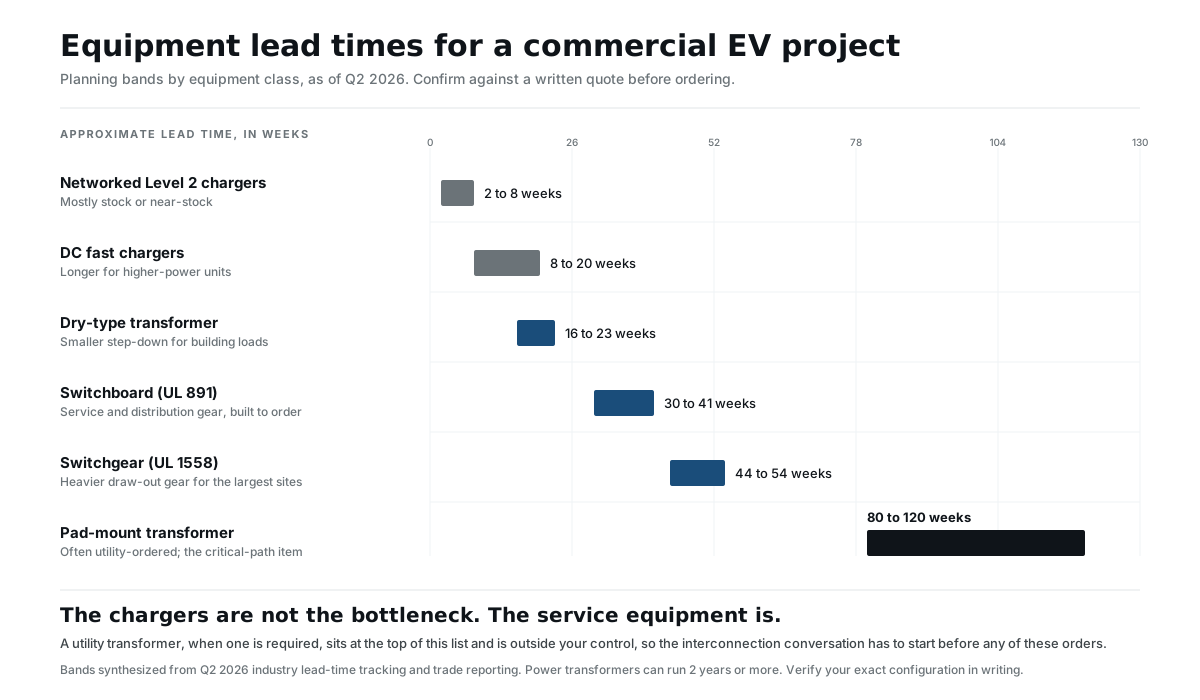
Two things about these numbers matter more than the numbers themselves. First, the chargers are not the problem; the service equipment is. An owner who orders chargers early and leaves the switchboard for "later" has protected the wrong item. Second, the utility's transformer, when one is required, sits at the top of this list and is outside your control, which is why the interconnection conversation has to start before any of these orders, not after. Our realistic timelines and delays article carries the full schedule context; this article's job is to turn these durations into purchasing decisions.
When to order: releasing to fabrication relative to the design
Here is the central tension of procurement on a long-lead job. The equipment takes months to build, so to hit a deadline you want to order early, but it is built to a specific design, so ordering before the design is final risks buying gear that no longer fits. Releasing an item "to fabrication on spec," meaning you commit the order before the design and the utility's requirements are locked, trades schedule for rework risk. Sometimes that trade is worth it; the skill is knowing when, and de-risking the bet.
The thing that changes most often, and most expensively, is the service. A switchboard's rating, its metering section, and whether it is even the right class of gear all depend on decisions the utility has the final say over: voltage, the size cap, the metering method, and which equipment it will accept. Order a switchboard before those are settled and you can end up with a metering section the utility rejects or a bus rating that no longer matches the load. That is not a change order; it is a new piece of gear and a new lead time.
So the de-risking rule is sequence-based, not speed-based:
- Lock the single-line diagram and the utility coordination first. The service voltage, the maximum service size, the metering method, and the utility's accepted-equipment list are the inputs that, once fixed, make the switchboard order safe. Getting the utility's service planning far enough along that these will not move is the highest-value thing you can do before any long-lead order.
- Then release the long-lead items, with the residual risk understood and owned. Once the single-line is stable and the utility has confirmed what it will accept, the switchboard and any customer transformer can be released to fabrication well ahead of permit approval; the remaining risk is small and known, rather than large and hidden.
- Run procurement in parallel with permitting, not after it. Permitting does not change the equipment specification the way utility coordination does, so waiting for the permit to clear before ordering simply burns weeks.
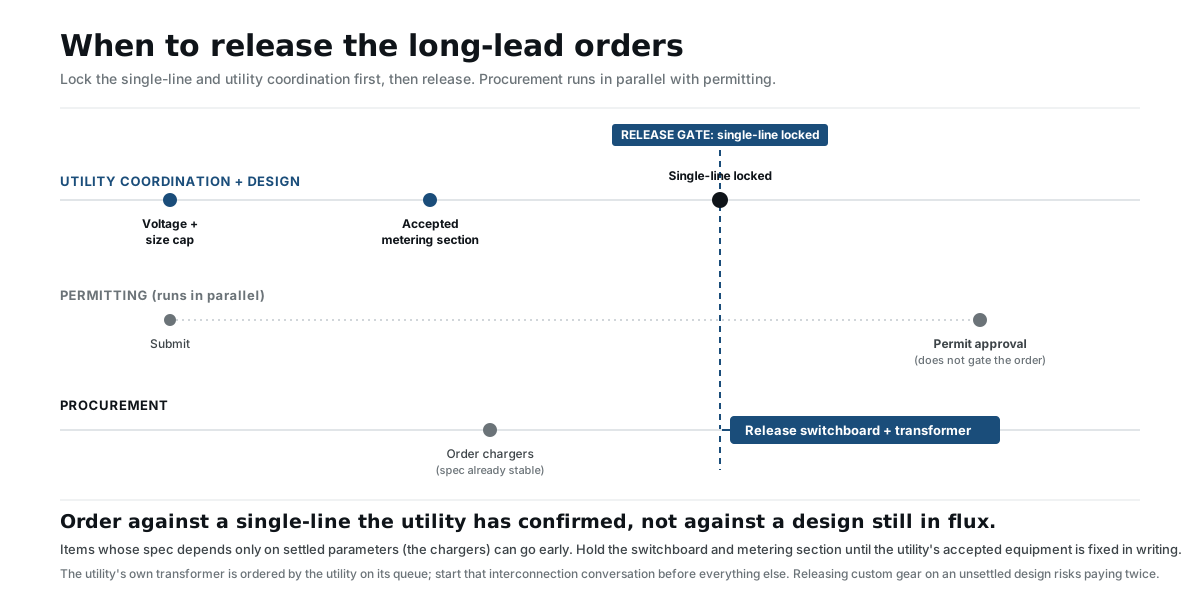
If a deadline forces you to order before the utility has fully signed off, you can, but treat it as a deliberate, priced risk. Get the engineer and the utility to confirm the four load-bearing parameters in writing first (voltage, service size, metering type, and the accepted metering section), because those are what turn an early order into scrap if they change. Then order only the items that depend on those settled parameters and hold the rest. An early order against a confirmed single-line is sound planning; an early order against a design still in flux is a gamble you may pay for twice.
Owner-furnished vs contractor-furnished equipment
Someone has to actually buy the long-lead gear, and there are two models. In contractor-furnished equipment (CFE), the electrical contractor procures the equipment as part of the installation contract; it flows through their purchase orders, their markup, and their warranty chain. In owner-furnished equipment (OFE), the property owner buys the equipment directly and provides it to the contractor to install. Both are common, and the right choice depends on who is best positioned to carry procurement, warranty coordination, storage, and risk.
| Dimension | Contractor-furnished (CFE) | Owner-furnished (OFE) |
|---|
| Who places the order | Electrical contractor | Owner, directly with manufacturer or distributor |
| Cost visibility | Bundled into the bid, often with markup | Transparent; owner sees the manufacturer price |
| Procurement effort | Contractor handles it | Owner handles it, including expediting and tracking |
| Warranty coordination | Single throat to choke; contractor owns the chain | Owner coordinates between manufacturer and installer |
| Storage and delivery risk | Contractor's responsibility | Owner's, until the contractor accepts it on site |
| "It arrived damaged / late" | Contractor's problem to solve | Owner's problem, which can become a finger-pointing dispute |
| Installation responsibility | Same party that bought it | Split: owner bought it, contractor installs it |
The tradeoffs follow from that table. CFE keeps responsibility in one place. If the gear is late, wrong, or damaged, it is the contractor's job to fix, and the warranty runs through a single party who also installed it, so there is no gap to argue over. You pay for that simplicity in markup and in less visibility into the equipment price.
OFE buys cost transparency and sometimes schedule control, at the cost of carrying risk yourself. Ordering early in your own name may secure a fabrication slot faster than waiting for the contract to be signed, and you see the real equipment price with no markup. But you now own the failure modes: an owner-furnished switchboard that arrives three weeks late can give the contractor a legitimate claim for delay and standby costs you cannot pass on; one that arrives damaged leaves you between a manufacturer who says it shipped fine and an installer who will not install damaged gear; and storage is yours, since a switchboard that arrives before the site is ready needs a dry, secure, indoor place to sit.
A few practical rules make OFE work when it is the right call:
- Pin the split of responsibility in writing. The contract should say exactly when the contractor takes responsibility for owner-furnished gear (usually on delivery and acceptance at the site), who inspects it for damage on arrival, and what happens to the schedule if it is late. Without that, a late or damaged OFE item becomes a dispute with no clear answer.
- Coordinate the warranty before you buy. Make sure the manufacturer's warranty survives the installer being a different party, and that someone (often the contractor, by agreement) owns warranty service after commissioning. A warranty no one is coordinating fails when you need it.
- Match OFE to items where the owner adds value. It earns its keep on a long-lead, high-value item where the early order date or the price transparency matters; owner-furnishing small, fast, stock items just adds coordination for no gain.
The common middle path is to owner-furnish only the one or two genuinely long-lead items (the transformer, the switchboard) and let the contractor furnish everything else, capturing most of the OFE benefit while keeping the bulk of the project under a single responsible party.
Deposits, cancellation, restocking, and substitution
Long-lead orders carry contract terms that ordinary purchases do not, because the manufacturer is committing fabrication capacity months ahead. Read these terms before you sign, because they decide what happens to your money if the design changes after you order.
Deposits and progress payments. Built-to-order gear usually requires money down to hold a fabrication slot, and often progress payments tied to milestones (engineering release, materials, assembly). The deposit secures your place in the queue, so it is also what you forfeit, in whole or part, if you cancel. Know the deposit amount and the milestone schedule before you release the order: paying the deposit is the moment the early-order risk becomes real money.
Cancellation and restocking. A built-to-order switchboard or transformer is not freely returnable; it was made for your single-line and may have no other buyer. Cancellation terms escalate with how far the build has progressed: cancel before fabrication and you may lose only the deposit; cancel after materials are committed or assembly has started and you may owe a large share of the price. Standard catalog items carry restocking fees instead. The further into fabrication a custom item is, the more a design change costs, which is exactly why locking the single-line before release matters.
Substitution and "or-equal" clauses. Specifications often name a manufacturer's equipment but allow an "or-equal" substitution, meaning the contractor may propose a different product that meets the same requirements. On long-lead gear this is double-edged. Used well, it lets the team pivot to a manufacturer with a shorter lead time when the named product is backordered, saving the schedule. Used poorly, a substitution slipped in to cut cost can bring gear the utility has not accepted or an inspector flags, restarting the very approval you were protecting. So the rule on EV projects is specific: any substitution on the service and metering equipment must clear the same utility acceptance and AHJ approval as the original, in writing, before it is ordered. An or-equal that saves four weeks but is not on the utility's accepted-equipment list trades a known delay for a worse one.
Coordinating the order with utility approval and with 30C timing
Two external clocks shape procurement, and they point in opposite directions. The first is utility approval, covered above and in switchgear and service equipment: the utility's accepted-equipment list, service-size cap, and metering requirements determine what gear is valid, so the sequence is non-negotiable, utility coordination first and then the long-lead release.
The federal 30C credit is the other clock, and it is effectively closed. The Section 30C Alternative Fuel Vehicle Refueling Property Credit has a hard placed-in-service deadline of June 30, 2026 under the One Big Beautiful Bill Act (Public Law 119-21). "Placed in service" means installed, energized, and capable of operating by that date, not ordered and not under construction. Given the lead times above, a project starting now cannot procure and install long-lead service equipment by June 30, 2026, so the credit is not realistically available to a new project; plan and budget the project on its own economics without assuming it. Above all, do not let a closed credit drive an early, under-coordinated order. Releasing a switchboard to fabrication on an unsettled design to "make the deadline" risks paying twice for gear you cannot finish in time anyway. Confirm any credit treatment with a tax professional; this site is independent and does not give tax advice.
Federally funded projects: NEVI and CFI change the rules
Everything above assumes a privately funded project. If your project draws federal money through the National Electric Vehicle Infrastructure (NEVI) program or the Charging and Fueling Infrastructure (CFI) program, two additional regimes shape procurement and labor. They do not apply to a privately funded job, so do not apply them to one, and do not assume a project is exempt until you have confirmed its funding source.
Build America, Buy America (BABA) domestic content. Under the FHWA Buy America waiver in effect since July 1, 2024, at least 55% of the cost of charger components must be of domestic manufacture (with final assembly already required to be domestic). This narrows which equipment you may procure: the product has to be on the right side of the rule, which can rule out otherwise-suitable hardware and interact with lead time, since compliant gear may have its own supply constraints. It is also a moving target. In February 2026 the FHWA issued a notice of proposed modification floating a rise in the threshold for charger components toward 100%, which industry groups warned no current manufacturer could meet. If your project is federally funded, confirm the rule in force at the time you procure, because the percentage and the compliant-product list can change. The program mechanics themselves live in federal programs: NEVI, CFI, IRA.
Davis-Bacon prevailing wage. Construction on projects funded in whole or in part by the Infrastructure Investment and Jobs Act, which includes NEVI and CFI, must pay Davis-Bacon prevailing wages, with certified payrolls. This is a labor-cost requirement rather than a procurement one, but it belongs in the same conversation because it changes the installed cost and contractor selection: a contractor bidding a NEVI site has to carry prevailing-wage labor, a contractor bidding a private site next door does not, and the bids are not comparable.
The single most important thing to get right here is the boundary. BABA domestic content and Davis-Bacon wages apply because of the federal funding, not because the project is EV charging. A privately funded commercial charging project carries neither, and applying them anyway just inflates cost for no reason. Conversely, a federally funded project that ignores them is out of compliance. Know which kind of project you are running before you write the procurement spec.
Consider a retail center adding a mix of networked Level 2 and two DC fast chargers, privately funded, no federal money. The electrical assessment shows the existing service cannot carry the new load, and the utility confirms a service upgrade requiring it to set a new pad-mount transformer. The site will take a 277/480V service through a new UL 891 switchboard with a CT-metering section.
The lead-time picture, as of Q2 2026. The networked Level 2 chargers are near-stock and the two DC fast chargers run about 12 to 16 weeks, so the chargers are nearly irrelevant to the schedule. The switchboard runs roughly 8 to 10 months, and the utility's transformer, which the utility orders and the owner does not control, is quoted at the long end and is clearly the critical-path item. The transformer and the switchboard are the schedule.
The order-timing decision. The owner starts the utility interconnection conversation immediately, since the transformer is the critical path and outside their control. For the switchboard, because the utility has not yet finalized which metering section it will accept, the owner holds the order until the utility confirms the accepted equipment and service-size parameters in writing, then releases to fabrication the moment the single-line is stable, well before the permit clears. The DC fast chargers, whose spec does not depend on that unsettled question, are ordered as soon as the model is chosen. That is the sequence rule in practice: lock the utility-dependent inputs, then release the long-lead item.
The OFE-vs-CFE decision. For the switchboard, OFE is tempting: it is expensive, so price transparency is worth real money, and ordering in the owner's name the day the single-line locks might secure a fabrication slot sooner than waiting for the contractor. Against that, an 8-to-10-month switchboard that arrives late or damaged becomes the owner's problem, including any delay claim, plus secure indoor storage. So the owner furnishes only the switchboard, the one long-lead, high-value item where order date and price matter, and lets the contractor furnish everything else, with the contract spelling out that the contractor inspects and accepts the switchboard on delivery, coordinates the warranty after commissioning, and gets a schedule adjustment if it arrives late through no fault of theirs. The transformer stays entirely with the utility.
The result is a clean division of risk: the owner controls and pays transparently for the one item where that matters, the contractor carries the bulk of the project under a single warranty, and the item nobody controls, the utility transformer, is acknowledged as the critical path from day one rather than discovered as a surprise.
The bottom line
Procurement on a commercial EV charging project is not paperwork; it is schedule and risk management. In 2026 the gear that sets your timeline is the transformer and the switchgear, not the chargers, and the shortage behind those lead times is structural, so plan against current written quotes and treat long-lead service equipment as the critical path. Order early to protect the schedule, but order against a single-line the utility has confirmed, because releasing custom gear on an unsettled design is how you pay for it twice. Decide deliberately who furnishes each long-lead item, and put the split of warranty, storage, and delay risk in writing rather than leaving it to be argued later. Treat the federal 30C credit as closed for planning, and apply BABA and Davis-Bacon only where federal funding actually triggers them. Get those decisions right and the long, slow part of the project runs in the background; get them wrong and the equipment becomes the reason the whole job stalls.
Last factually verified: 2026-06-19 against Wood Mackenzie transformer and T&D supply-chain reporting (pad-mount three-phase shortage and demand drivers), Power Magazine "Transformers in 2026" and EE Power transformer supply-chain reporting (grain-oriented electrical steel constraint and Cleveland-Cliffs as sole U.S. GOES producer), International Energy Agency 2026 grid reporting (~98% global transformer manufacturing utilization), industry electrical-equipment lead-time tracking and ELSCO pad-mount transformer lead-time reporting (Q1-Q2 2026 transformer and switchgear lead-time bands), FHWA Buy America guidance for EV chargers (55% domestic-content waiver effective July 1, 2024, and the February 2026 notice of proposed modification toward up to 100%), DOT/FHWA and DOE Joint Office NEVI standards and Crowell & Moring analysis of the federal EV charging standards (Davis-Bacon prevailing-wage applicability to IIJA-funded construction), and IRS Section 30C guidance with Public Law 119-21 (placed-in-service deadline of June 30, 2026). Lead-time figures are planning bands as of Q2 2026 and should be confirmed against written quotes at time of purchase.